How Big Is a 17 Day Old Baby's Stomach
Written by Jody Segrave-Daly, RN, IBCLC
As a veteran NICU, nursery nurse, and lactation consultant, I have cared for and fed thousands of babies over the past thirty years. When working in the special intendance nursery, babies are fed co-ordinate to their weight and cumulative losses to determine their caloric requirements for intake amounts and optimal nourishment. For instance, term babies admitted to the NICU from complications of hypoglycemia (low blood sugar) are immediately fed based on their weight, usually nearly 60-80 ml/kg/day (typically 15-thirty ml) every 2-iii hours. Newborns fed xv-xxx ml will likely accept their insufficient feeding complications stabilized and demonstrate feeding satisfaction and comfort because the newborn stomach is at least four times larger than what is taught.
First, we should review the anatomy of the newborn digestive organization.
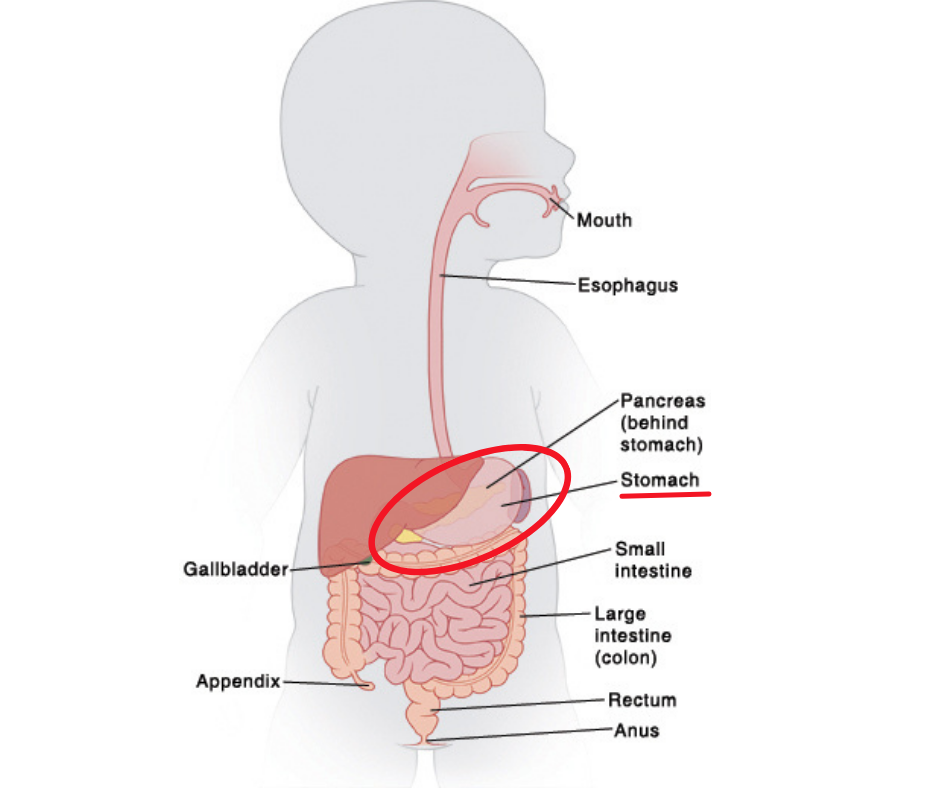
Newborn digestive system. Photo credit St. Lukes Infirmary Organization, KS
Gastric emptying is a continuous movement into the small intestine which accommodates milk book to be more than 5-7 ml every two-3 hours. The tummy is a muscular and very stretchable organ. Its biological function is to expand to hold food and fluids while churning with digestive enzymes before entering the duodenum or small intestine. A full-term baby swallows 500-1000 ml of amniotic fluid every day. Ultrasound can confirm the stomach's size and measure when the infant swallows amniotic fluid. The newborn tum does not magically or suddenly abound later day one every bit taught to parents. My business concern as a long-fourth dimension NICU nurse, infant feeding specialist, and IBCLC has e'er been why mothers are taught their exclusively breastfed newborn baby's stomach capacity is only 5-7 mL on day one, which is faux.
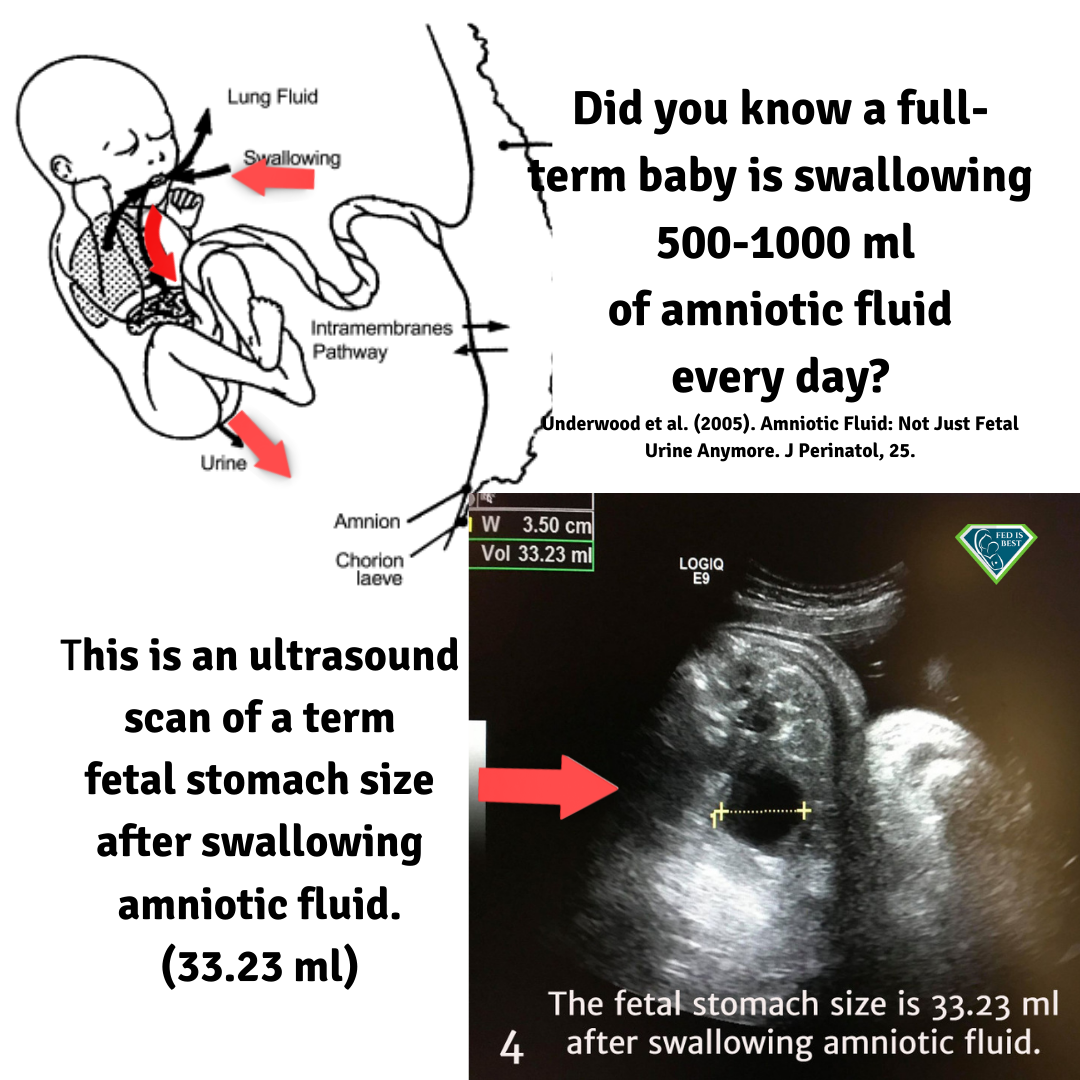
The Myth of the Newborn Stomach Size: Where Did it Come From?
I started my inquiry with my not-clinical chapeau on and turned to Google since this is where my patients typically become first. When I did a Google search for newborn stomach sizes, at that place were over 868 thou links! I was led to a plethora of visual images depicting newborn stomach size. Some of the almost pop images were the belly brawl models that lactation consultants article of clothing on their lanyards and then they tin can visually educate new mothers how big their ' newborn's tum size is.'
I was in accented disbelief knowing our nigh truste d lactation co nsultants were selling, wearing and using, proudly I might say very inaccurate, dangerous and non-bear witness based tools that are used in hospitals. I quickly began to understand that 'belly bead' models are lucrative merchandise to sell!
Clinical hat back on, I dug into the science behind these belly balls. In the 2008 Journal of Human Lactation, I plant a published article that revealed a completely different utility for belly ball models.
Marble/brawl models are ofttimes used to represent newborn tummy capacity; however, their accuracy has not been determined:
"Measurement of infant tum capacity has been attempted for ove r 100 years. Exact volumes cannot be standardized, but data suggest that anatomic stomach chapters and physiologic stomach capacity vary widely." In addition, "It is of import to note that because a broad range of feeding volumes on day one (1-20 mL) and day three (thirteen to 103 mL) has been reported, and the reasons for these variances are unclear, it may be best to just acknowledge that feeding volumes vary widely and like stomach capacity, practice not lend well to the visual representation given our current knowledge."
This inquiry was published in the Periodical of Human Lactation and yet, not a unmarried lactation professional is practicing what the bear witness says. How can this exist?
Despite that qualification, new moms are inundated with images where there are a serial of bottles filled with milk depicting the size of an infant's stomach according to each day afterwards nativity, sometimes compared with fruit or dissimilar-sized marbles and balls. A mother sent this picture to united states of america, which was in her infirmary room later the nascency of her baby. She also received inaccurate educational activity near the newborn stomach size and thought her formula-fed infant only needed v ml at each feeding.

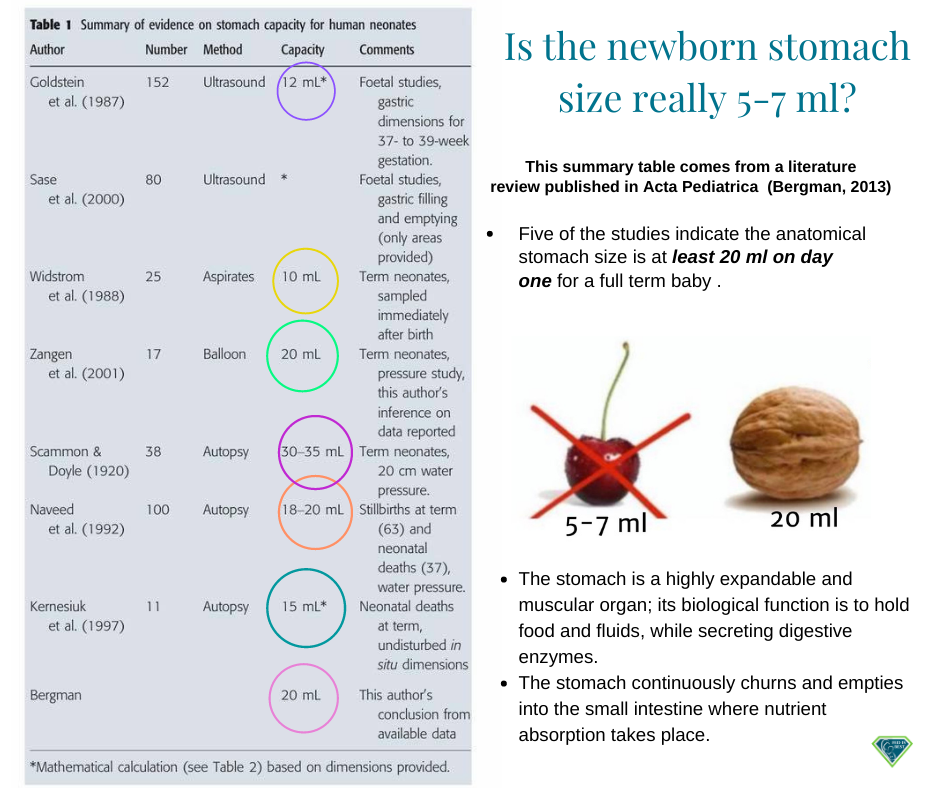
This data is Imitation and based on enquiry from 1920.
I continued to search for more resources, and I constitute research in 2013 from Nils J. Bergman who published this study , which says:
"At that place is insufficient show on optimal neonatal feeding intervals, with a wide range of practices. The tummy capacity could decide feeding frequency. A literature search was conducted for studies reporting volumes or dimensions of stomach capacity before or subsequently birth. Six articles were found, suggesting a stomach capacity of 20 ml at birth."
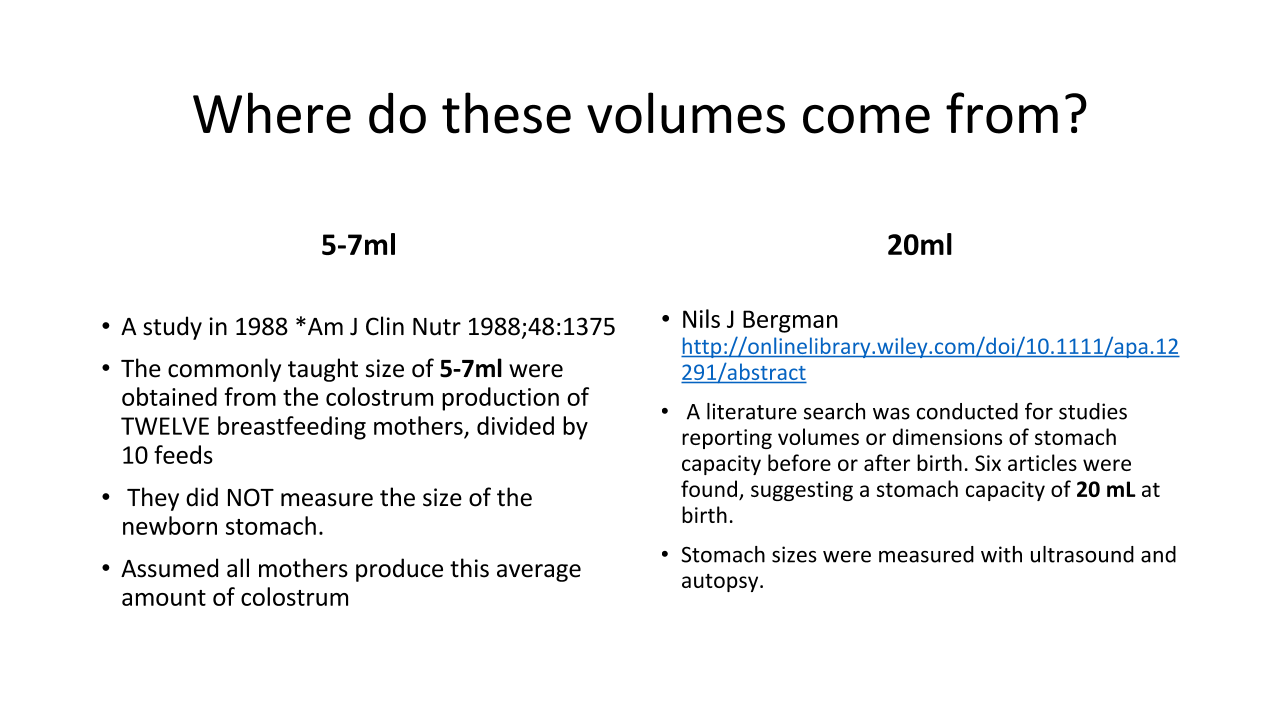
Co-ordinate to Dr. Bergman, "There is reasonable consensus on the amount of milk that human being term newborn infants need per day, figures given vary from 150 to 160 mL/kg/day." This means that an average 3 kg or vi.6 lb newborn requires 450-480 mL or 16 ounces of milk a day. At 66 Calories/dL, this would roughly be 100-106 Cal/kg/24-hour interval, which is the published daily caloric requirement for a newborn. This total volume can exist given in smaller volumes more frequently or larger volumes less often, 2 ounces every 3 hours or 1.3 ounces every two hours.
His article poses the hypothesis that the feeding interval should be 20 mL every i hour, assuming that the stomach empties but once every hour.
Nonetheless, the real-life clinical application of his suggested feeding interval would apace atomic number 82 to maternal and newborn burnout from lack of slumber and increased risk of postnatal depression, breastfeeding cessation, and fifty-fifty suffocation from a mother falling comatose with her newborn during breastfeeding. In addition, his feeding interval does not accept into account that the breadbasket actually empties during feeding and therefore the feeding capacity of a newborn is higher than xx mL. The clinical expertise of neonatal health professionals has shown that even one-day-old newborns are able and do comfortably tolerate 15-30 mLs per feeding.
Additional newborn tum size inquiry
Most popular breastfeeding education resources for new parents also refer to inaccurate data past educational activity the stomach size is 5-7 ml on day one. This picture is from a mother who delivered in a Baby-Friendly Hospital this week. Imagine her confusion when her baby required additional amounts of supplementation to care for hypoglycemia.
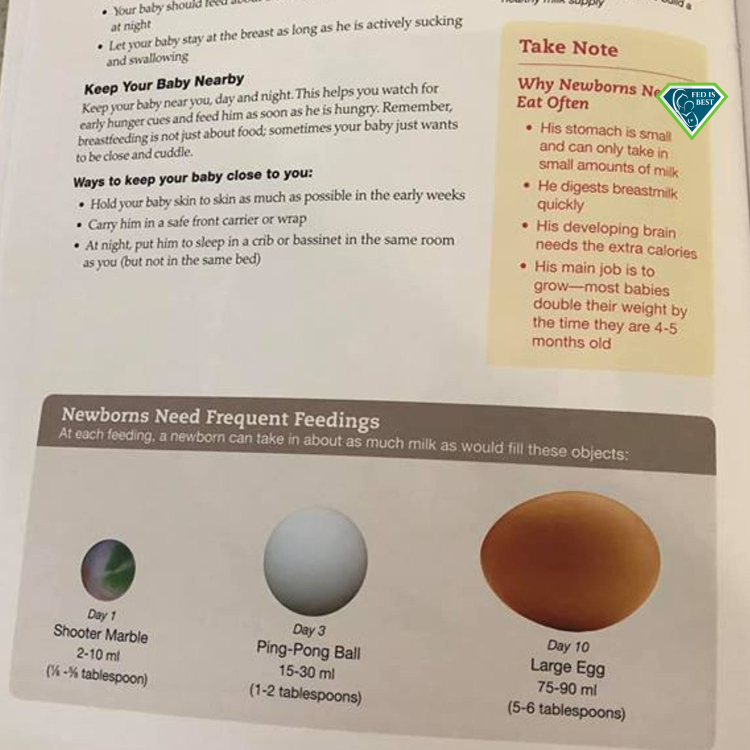
No one could explain to her why her baby could comfortably tolerate more milk than what she was taught in this infirmary education resource booklet.
Dr. Gomez, a neonatologist, explains why hypoglycemic babies (low blood sugar) need more than 5 ml of milk despite being told their baby'due south breadbasket can only hold v ml.
"We don't accept any strong testify as to the size of the tummy for each baby. Nevertheless, we do have significant scientific evidence that hypoglycemia and under-hydration crusade harm to the brain of the babe.
Nosotros have solid evidence that feeding babies 10-20 mls when they are born is acceptable to keep the blood glucose levels up in most babies. Some will still need some other interventions, merely 10- twenty ml feedings are enough near of the time.
In that location is no evidence that feeding 10 to 20 ml of milk to a infant causes "stretching of the stomach," and we don't take ANY bear witness that this is detrimental to the baby."
We have evidence that judicious supplementation helps babies and does not impact breastfeeding rates.
So the question is, are we hurting babies by supplementing? NO. Are we hurting babies past non supplementing and assuasive them to have hypoglycemia or dehydration? Aye.
According to the Academy of Breastfeeding Medicine Supplementation Protocol, they suggest exclusively breastfed babies are fed 2-x ml per feeding, and they reference the infant tummy size according to outdated studies (1992 and 1920) to reflect intake volume . They also say at that place is no definitive research bachelor and the amount of supplement given should reflect the normal amounts of colostrum available, the size of the baby'due south tum, and the age and size of the infant. The fluid and caloric intake on day ii mail-birth should be higher than day one in relation to the infant'south caloric demand. Based on the limited inquiry bachelor, suggested breast milk intakes for healthy, term infants their feedings should be based on satisfaction cues despite their guidelines. Unfortunately, this information contributes to additional confusion that already exists for parents. What they practice say is research is necessary to establish evidence-based guidelines on advisable supplementation volumes for specific conditions and whether this varies for colostrum versus infant formula.
But why don't we already know this if an baby feeding protocol has been implemented in hospitals? Protocols are supposed to be peer-reviewed for scientific accuracy.
Speaking of HUNGER cues and feeding your baby to satisfaction, here are signs that your newborn baby needs immediate attending:
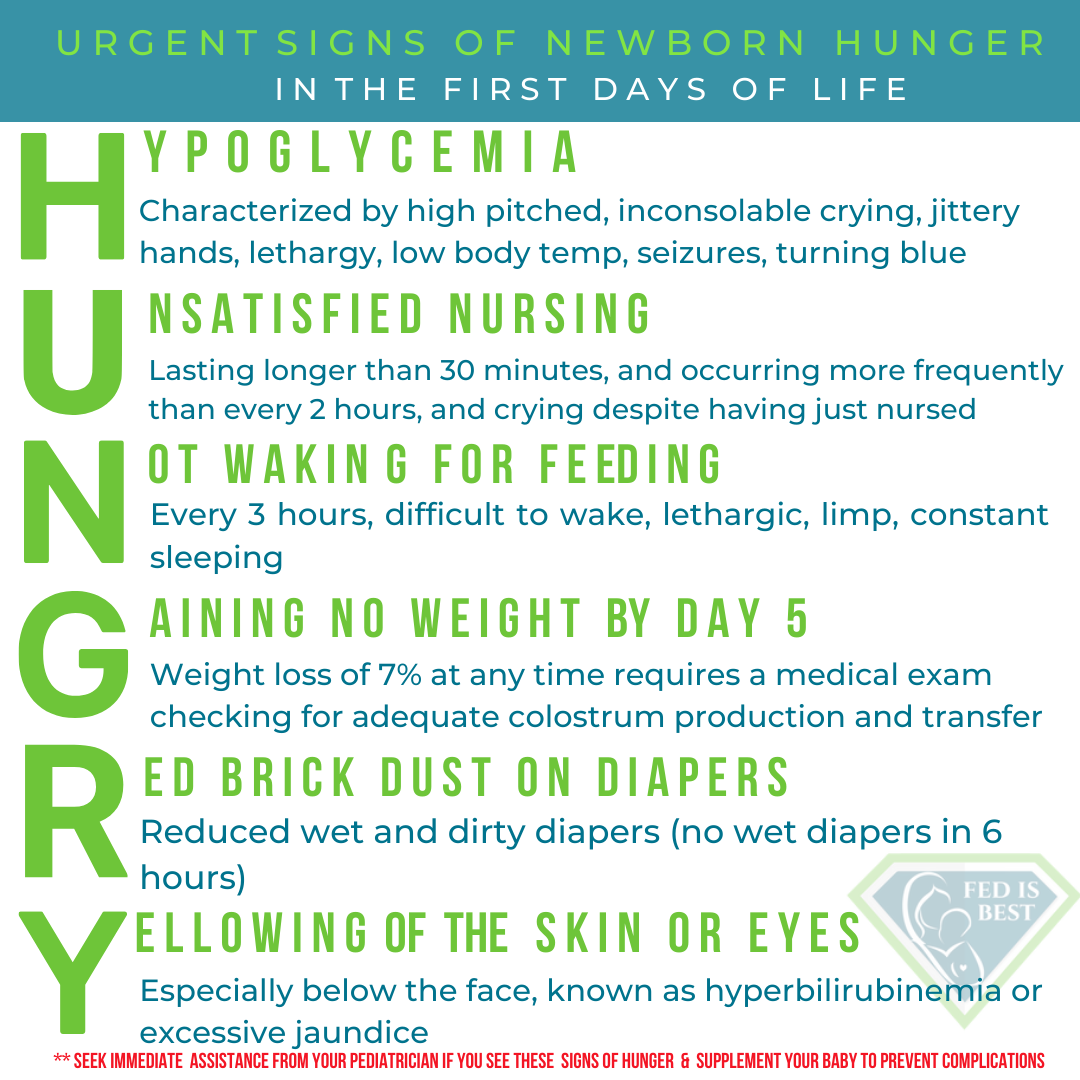
Nosotros take been talking about the newborn tummy size just What nigh calories? How many calories do human milk, infant formula, and colostrum contain in v-7 MLS?
What enquiry tells us is :
- Mature breast milk averages effectually 20 calories per ounce (~30 mL)
- and babe formula contains 20 calories per ounce besides.
- Colostrum is lower in fat and carbohydrates and comes in around 17 calories per ounce (~30ml) (Guthrie 1989).
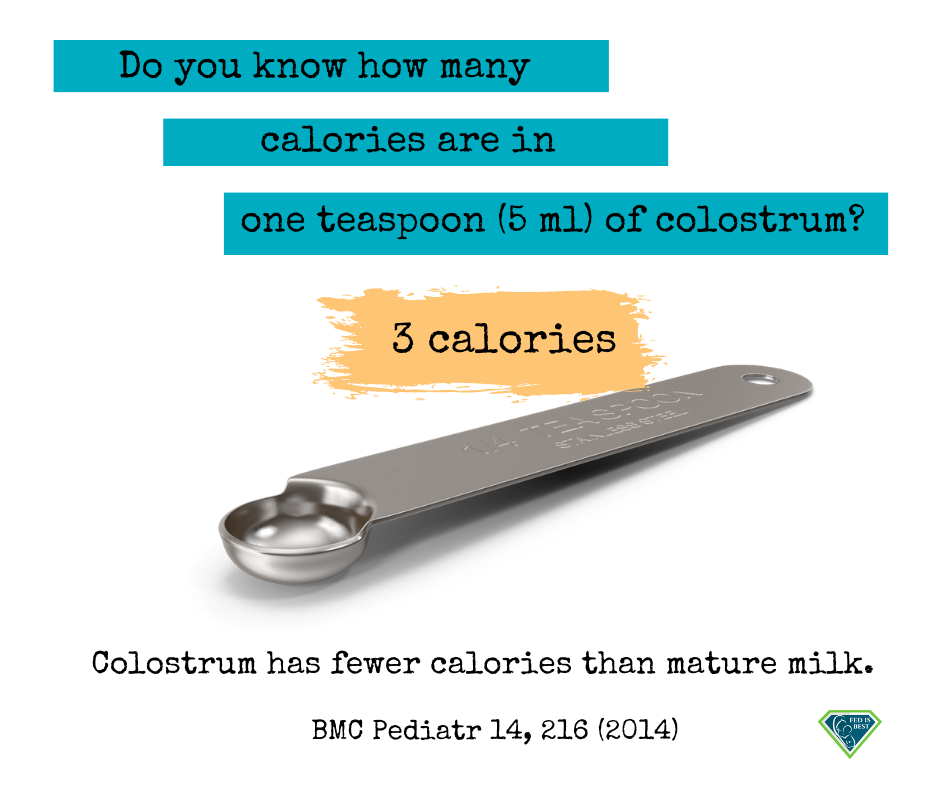
How many calories do term newborns need to ensure Cell Survival?
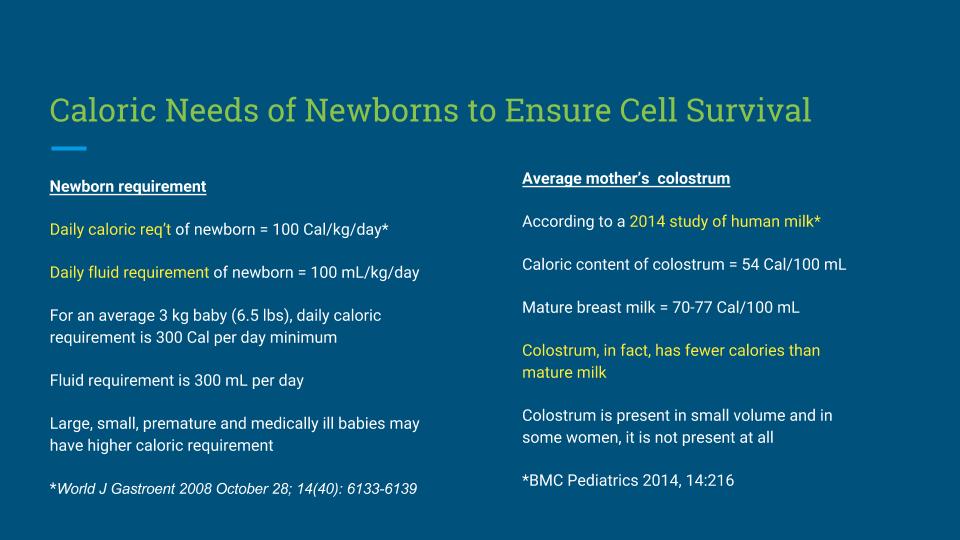
As you can see, exclusively breastfed newborns cannot thrive on three calories per v ml (ane teaspoon) of colostrum at each feeding.
Why do some babies tolerate fasting before the onset of copious milk production and other babies do not?
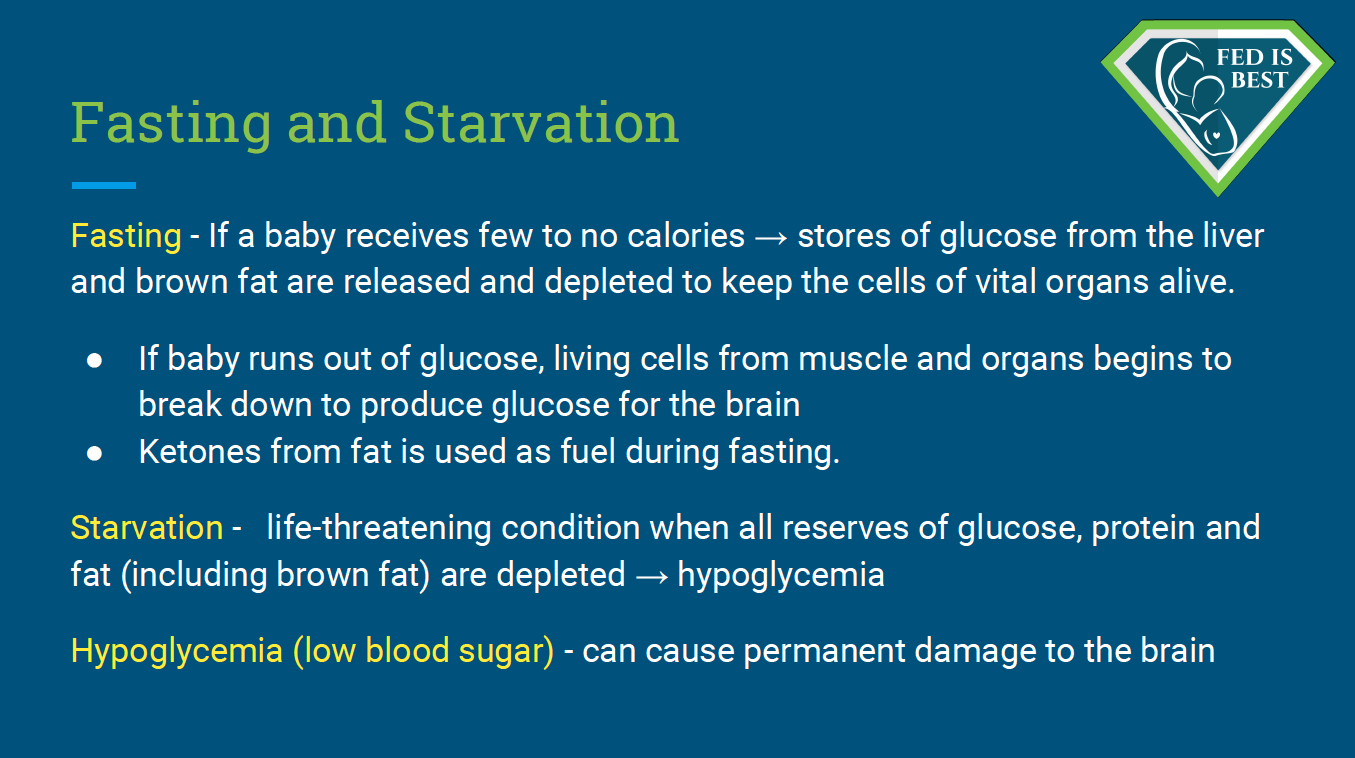
Some exclusively breastfed babies are fasting after birth if they are not receiving plenty colostrum. 1 in five new mothers volition feel delayed onset of copious milk production from various risk factors. This puts these babies at risk for developing complications from insufficient colostrum intake while breastfeeding.
1 in 71 exclusively breastfed babies are rehospitalized for life-threatening complications from bereft colostrum intake. Every bit lactation and neonatal medicine professionals information technology is imperative to update our educational resources and identify the babies who may need timely supplementation before the onset of copious milk production. For mothers who want to exclusively breastfed, donor milk should be made available for them to use if supplementation is needed. In club for babies to receive the full benefits of breastfeeding, they need to exist safely fed at every feeding.
Then how often should exclusively breastfed babies eat?
At that place is no single correct reply to this question because each baby has a different weight and unique caloric requirement. By merely weight solitary, a 6.6-pound infant has an average size stomach of 20 mL on twenty-four hour period one and would crave forty mL or 1.3 oz of chest milk or formula every 2 hours to run into their bones metabolic needs or 60 mL every 3 hours. Only babies should as well be fed by infant cues to satisfaction. In other words, if your baby is crying and crying after breastfeeding, an firsthand medical exam is necessary to exist sure the infant is not suffering from insufficient intake of colostrum while exclusively breastfeeding. If a medical evaluation is not immediately bachelor, especially before the milk has come in, In that case, supplementation may be urgently needed before medical evaluation is bachelor to foreclose serious complications of insufficient feeding.
Every bit yous tin can see, It'southward time to ban the false belly bead models and update our breastfeeding instruction resource immediately. Our babies count on us to keep them well-fed, meeting their metabolic needs with sufficient milk and using the best and nigh electric current babe feeding practices possible. This flawed product is harming too many babies.
As y'all tin can see, It's time to ban the fake belly bead models and update our breastfeeding teaching resources immediately. Our babies are counting on us to keep them well-fed, meeting their metabolic needs with sufficient milk and using the all-time and virtually current infant feeding practices possible. Too many babies are being harmed by this flawed product.
Was your baby harmed by the belly bead lanyard product?
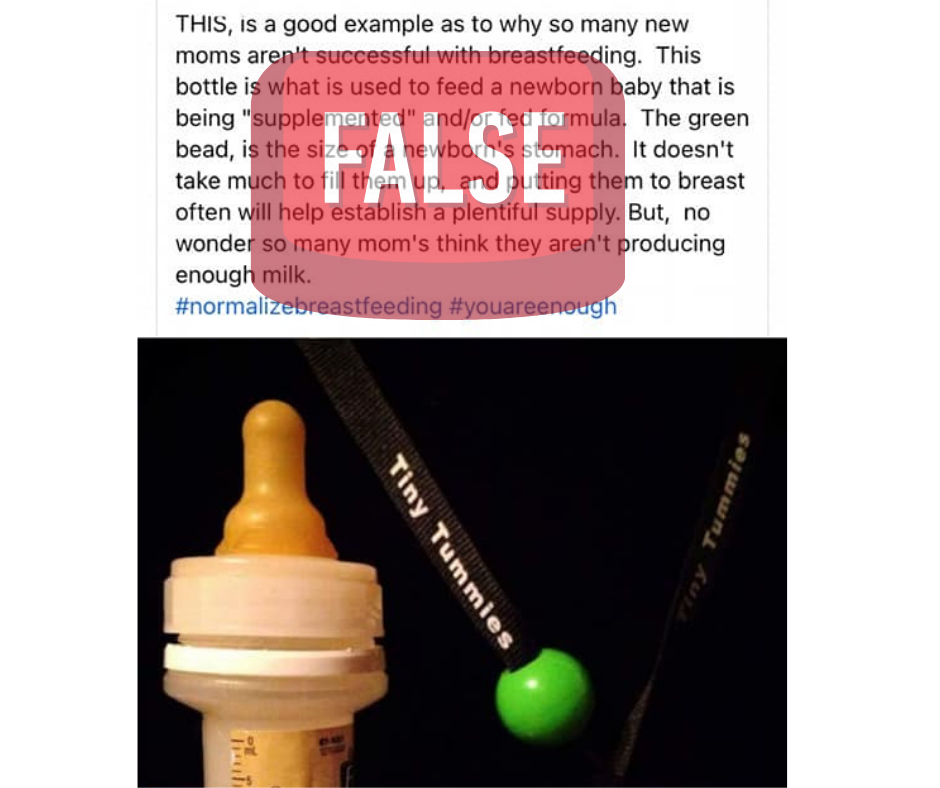
A mother writes: "Considering of this stupid belly bead, my baby was discharged from the hospital despite non eating enough breastmilk. He had a seizure at home and was taken back to the hospital past an ambulance for dehydration."
- To file a formal complaint about the abdomen bead lanyard company, click hither.
- If your baby was harmed from bereft feeding related to this lanyard, click hither for legal counsel.
- To study the belly dewdrop lanyard to the FDA for a faulty medical device used in a hospital, click here to MEDWATCH online voluntary reporting class
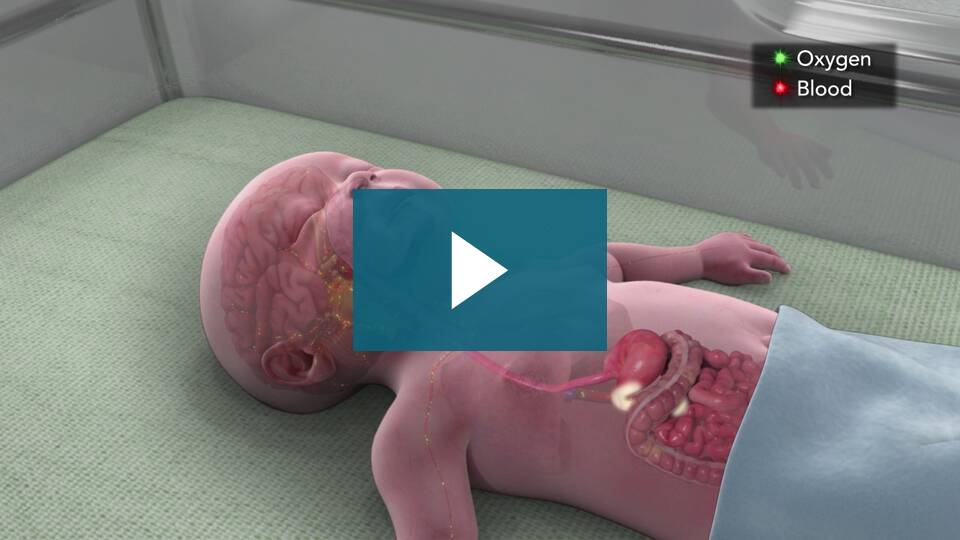
Normal Newborn Anatomy and Function | High Impact® Visual Litigation Strategies™
Boosted enquiry about the newborn tum size:
The Pediatric Surgery Journaldescribes the newborn breadbasket anatomy, including the size of xxx ml at nascency:
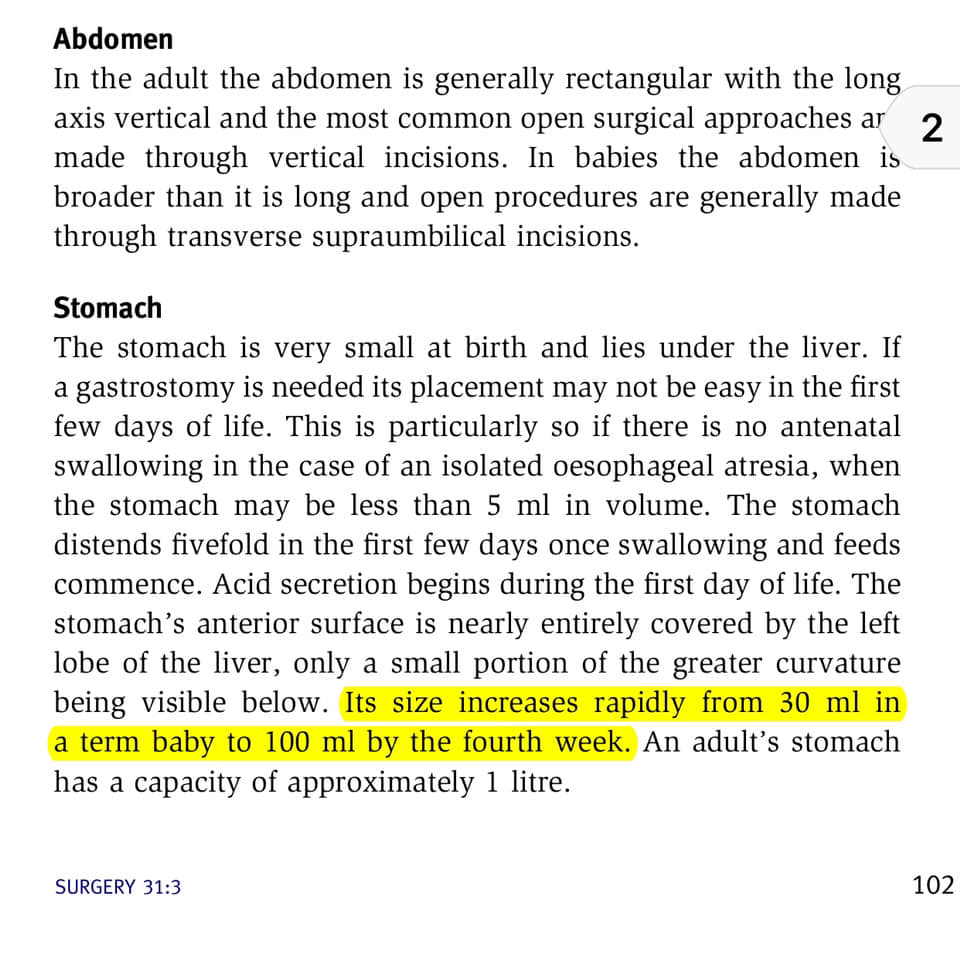
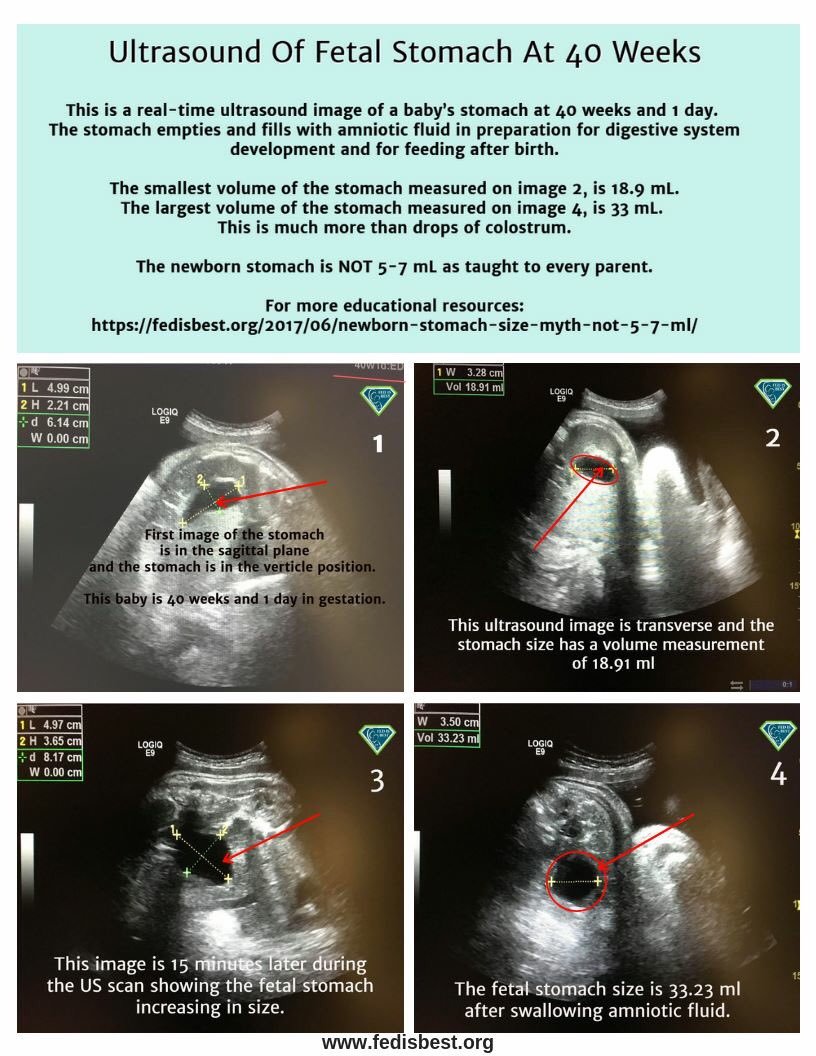
Pediatric Beefcake Surgery Journal
Normal third-trimester fetal anatomy -ultrasound videos: the abdomen:
Guthrie, Helen Andrews. Introductory Nutrition. St. Louis : Times Mirror/Mosby College Pub., 1989
Breastfeeding confidence and measurement of milk intake
The American Academy of Pediatrics' Breastfeeding Guidelines
Helpful guide to condom infant feeding amounts from the American University of Pediatrics.
Helpful overview of infant feeding for the first month of life, from the American Academy of Pediatrics.
https://fedisbest.org/2018/10/feeding-your-infant-when-supplementing-saves-breastfeeding-and-lives/
Normal Human Lactation; endmost the gap
Legal Consultation on Breastfeeding Complications Resulting in Disability
If I Had Given Him Just One Bottle, He Would Be Alive.
HOW Y'all CAN SUPPORT FED IS BEST
There are many ways y'all can back up the mission of the Fed is Best Foundation. Delight consider contributing in the following ways:
- Join the Fed is All-time Volunteer group to help us attain Obstetric Health Providers to advocate for counseling of new mothers on the importance of rubber infant feeding.
- Join our private Wellness Care Provider Advocacy grouping on Facebook
- Make a donation to the Fed is Best Foundation. We are using funds from donations to cover the price of our website, our social media ads, our printing and mailing costs to reach health providers and hospitals. We do not accept donations from breast- or formula-feeding companies and 100% of your donations go toward these operational costs. All the work of the Foundation is achieved via the pro bono and volunteer work of its supporters.
- Share the stories and the bulletin of the Fed is Best Foundation through word-of-oral cavity, by posting on your social media page, and by sending our resource to expectant moms that you know. Share the Fed is Best campaign alphabetic character with anybody you know.
- Write a letter to your health providers and hospitals nearly the Fed is Best Foundation. Write them most feeding complications your child may have experienced.
- Print out our letter of the alphabet to obstetric providers and postal service them to your local obstetricians, midwives, family practitioners who provide obstetric care, and hospitals.
- Write your local elected officials nigh what is happening to newborn babies in hospitals and ask for legal protection of newborn babies from underfeeding and of mother's rights to honest informed consent on the risks of insufficient feeding of breastfed babies.
- Send us your stories. Share with usa your successes, your struggles, and everything in betwixt. Every story saves another child from experiencing the same and teaches another mom how to safely feed her baby. Every voice contributes to change.
- Send us messages of support. Nosotros work every single solar day to brand infant feeding safe and supportive ofevery mother and child. Your messages of support proceed us all going.
Donate to Fed is All-time
Thank you so much from the Founders of the Fed is Best Foundation!
Jody and Christie
Source: https://fedisbest.org/resources-for-parents/the-newborn-stomach-size-myth-it-is-not-5-7-ml/
0 Response to "How Big Is a 17 Day Old Baby's Stomach"
Enregistrer un commentaire