what happens to the chincoteague ponies in a hurricane
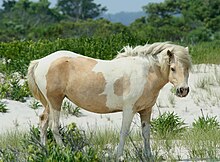 Chincoteague pony | |
| Other names | Assateague horse |
|---|---|
| Country of origin | Us |
| Traits | |
| Distinguishing features |
|
| Breed standards | |
| |
| |
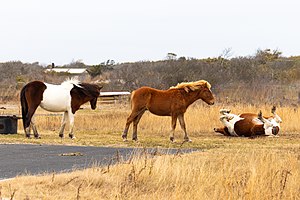
Horses play most a campsite on Assateague Island
The Chincoteague pony, too known every bit the Assateague equus caballus, is a brood of horse that developed and lives in a feral condition on Assateague Island in the states of Virginia and Maryland in the Us. The breed was made famous by the Misty of Chincoteague series of novels written by Marguerite Henry starting in 1947. While phenotypically horse-like, they are commonly called "ponies". This is due in part to their smaller stature, created by the poor habitat on Assateague Island. Variation is found in their physical characteristics due to blood from unlike breeds beingness introduced at various points in their history. They can be any solid color and are ofttimes constitute in pinto patterns, which are a favorite with breed enthusiasts. Island Chincoteagues live on a diet of salt marsh plants and brush. This poor-quality and often deficient food combined with uncontrolled inbreeding created a propensity for conformation faults in the Chincoteague before outside blood was added showtime in the early 20th century.
Several legends are told regarding the origins of the Chincoteague ponies; the most popular holds that they descend from survivors of wrecked Spanish galleons off the Virginia coast. It is more than probable that they descend from stock released on the island past 17th-century colonists looking to escape livestock laws and taxes on the mainland. In 1835, the practice of pony penning began, with residents rounding up ponies and removing some of them to the mainland. In 1924 the first official "Pony Penning Day" was held by the Chincoteague Volunteer Fire Company, where ponies were auctioned as a fashion to raise money for burn down equipment. The annual event has continued in the same fashion almost uninterrupted to the present day.
Although popularly known as Chincoteague ponies, the feral ponies live on Assateague Island. The unabridged island is endemic past the federal government and is dissever by a argue at the Maryland/Virginia state line, with a herd of around 150 ponies living on the Virginia side of the debate, and 80 on the Maryland side. The herds live on land managed by two different federal agencies with very different management strategies. Ponies from the Maryland herd, referred to in the literature of the National Park Service every bit Assateague horses, alive inside Assateague Isle National Seashore. They are by and large treated as wild animals, given no more or less assistance than other species on the isle, other than to be treated with contraceptives to forbid overpopulation. Conversely, the Virginia herd, referred to equally Chincoteague ponies, lives within the Chincoteague National Wildlife Refuge but is owned by the Chincoteague Volunteer Fire Company. The Virginia ponies are treated to twice yearly veterinarian inspections, which set them for life among the general equine population if they are sold at sale. While only effectually 300 ponies alive on Assateague Island, around one,000 more live off-island, having been purchased or bred by individual breeders.
Characteristics [edit]

A bay pony from the Maryland herd among the plants which make up its diet
While phenotypically horses, the Chincoteague is well-nigh often referred to as a pony breed.[1] Chincoteagues boilerplate around 13.ii hands (54 inches, 137 cm) in their feral state, simply grow to at least 14.2 hands (58 inches, 147 cm) when domesticated and provided meliorate nutrition. They generally weigh around 850 pounds (390 kg). All solid colors are institute in the breed, as are pinto patterns. Horses with pinto coloration tend to sell for the most money at the annual auction. Due to outside bloodlines being added to the Chincoteague herd, there is some variation in physical characteristics. In full general, the breed tends to take a straight or slightly concave facial contour with a broad forehead and refined throatlatch and neck. The shoulders are well angled, the ribs well sprung, the chest broad and the back curt with broad loins. The croup is rounded, with a thick, depression-ready tail. The brood'southward legs tend to be straight, with good, dense os that makes them audio and sturdy.[2] Domesticated Chincoteagues are considered intelligent and willing to please.[1] They are viewed as like shooting fish in a barrel to train, and are used as hunter, driving and trail ponies.[two] In terms of wellness, they are generally hardy and easy keepers (able to alive on petty food).[one] In the late 19th century, 1 writer praised their "adept manners and gentle disposition" while reporting the story of one pony who was ridden a distance of around 1,000 miles (1,600 km) in 34 days by a man with equipment, a load that weighed around 160 pounds (73 kg)—the pony weighed approximately 500 pounds (230 kg).[3]
History [edit]
Legend states that Chincoteague ponies descend from Spanish horses shipwrecked off the Virginia coast on their way to Republic of peru in the 16th century.[4] Another story holds that they descend from horses left on the isle by pirates. Both of these theories are unlikely, as no documentation has been establish to prove horses inhabiting the isle this early, and no mention of horses already existing on the island was made past colonists on either the mainland or the isle in the mid-to-late 1600s.[5] Bear witness points, however, to their ancestors actually existence horses brought to the islands in the 17th century by mainland farmers. Livestock on the islands were not discipline to taxes or fencing laws, and so many animals, including hogs, sheep, cattle and horses, were brought to the islands.[2] While the National Park Service holds to the theory that the horses were brought to the isle in the 17th century,[6] the Chincoteague Volunteer Fire Company, which owns the ponies on the Virginia side of Assateague,[6] argues that the Spanish shipwreck theory is correct. They argue that horses were as well valuable in the 17th century to have been left to run wild on the island, and merits that there are 2 sunken Spanish galleons off the Virginia coast in support of their theory.[ane] The National Chincoteague Pony Association likewise promotes the shipwreck theory.[7] In the early on 1900s, they were described as having been on the islands since well before the American Revolution, and were described at that time as "very diminutive, but many of them are of perfect symmetry and boggling powers of activeness and endurance." In the early 1800s, Virginia governor Henry A. Wise released what 1 author chosen the "earliest printed testimony" on the Chincoteague.[8]
During the 1920s, before the herds were managed by various agencies, many conformation faults were plant—the effects of uncontrolled inbreeding. Misshapen legs, narrow chests, poor bone and a lack of substance plagued the breed, with many stunted animals not growing above 12 hands (48 inches, 122 cm). This was partially due to the limited and poor-quality feed found on the islands, although this harsh habitat too allowed just the hardiest and most adaptable ponies to survive. Welsh and Shetland pony blood was added to upgrade the stock, and horses with pinto coloring were introduced to give the herd its common distinctive patterns and contribute to the more horse-like phenotype of the breed.[4] Twenty Mustangs owned by the Bureau of Land Management were introduced in 1939. Arabian blood was added in the hopes of calculation refinement and summit to the breed, as well as increasing the length of their legs. Arabian stallions were used at ii different points within the breed history: one was released with the herd, but did not survive, while another was bred to mares that had been removed from the island for breeding and then returned once in foal.[ii] The Chincoteague pony has a similar history to the Shackleford Broker Horse, which comes from the Shackleford Banks off the coast of North Carolina. However, the Shackleford is a more isolated population, with no outside blood added to the island herd.[9]
The island itself has also undergone alter. At once, the isle was connected to the lowest point of Fenwick Island. In August 1933, a hurricane created an inlet south of Bounding main City, Maryland,[10] separating the two landforms. Subsequently the storm, between 1933 and 1935, a permanent system of artificial jetties was congenital to preserve the inlet as a navigation aqueduct.[11] As a result of the jetties disrupting sand motility in the area, the island has drifted considerably westward, and the 2 landmasses are now over ane kilometer (0.62 mi) apart.[10]
Pony penning [edit]
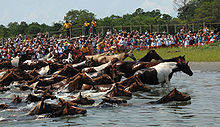
In 1835, the first written clarification of "pony penning" (roundup) appeared, though the exercise of rounding up livestock on the island existed for many years before that. Initially, unclaimed animals were marked for ownership by groups of settlers. By 1885, the result had get a festival twenty-four hour period, and two days of equus caballus and sheep roundups were held on Assateague and Chincoteague Islands. While the sheep population macerated over fourth dimension, the pony population grew.[two] In 1909, the terminal Wednesday and Thursday of July were designated every bit the almanac days for pony penning, nevertheless taking identify on both Assateague and Chincoteague Islands. Withal, in the early on 1920s, much of Assateague Island was purchased by a wealthy farmer, forcing many settlers to movement to Chincoteague Island and necessitating a alter in the pony penning format. By 1923, all parts of pony penning except for the actual roundup had moved to Chincoteague Island, with the ponies being transported past truck for the get-go two years before the annual swim was begun.[12] Past the early 1900s, Chincoteague Island had been established as a tourism and sport oasis, and in 1922, a causeway was completed that connected the isle to the Virginia mainland. After a pair of fires ravaged Chincoteague Isle that same year, the Chincoteague Volunteer Fire Company was established. In 1924, the get-go official Pony Penning Twenty-four hours was held, where the foals were auctioned at $25–50 each to raise money for fire equipment. Pony Penning Day has been held annually ever since, with the exception of 1942, 1943, and 2020.[2]
Currently as many every bit fifty,000 visitors gather on the terminal Wednesday in July to lookout man mounted riders bring the Virginia herd from Assateague and swim them across the channel to Chincoteague Island. The swim takes five-x minutes, with both the passenger and the observers on mitt to help horses, peculiarly foals, who may have a difficult time with the crossing.[2] Earlier the swim, the herd is evaluated and mares in the late stages of pregnancy and those with very young foals are removed from the herd to be trailered between the islands. During the swim, some lactating mares get affected with hypocalcemia, which is treated by on-site veterinarians.[13] Larger foals are auctioned the next twenty-four hours and the majority of the herd, including any immature foals, are returned to Assateague on Friday.[2] As of 2015, the highest price paid for a pony was $25,000 and the everyman price was $500. Some ponies are purchased under "purchase back" atmospheric condition, where the bidder donates the coin to the fire department but allows the pony to be released back onto Assateague Island.[fourteen]
Breed registry and preservation [edit]
The National Chincoteague Pony Association (NCPA) was founded in 1985 and the International Chincoteague Pony Clan and Registry (ICPAR) was founded in 2021. The associations maintain a studbook and register ponies from the annual fire company auction and ponies from private breeders. The ICPAR registrars half Chincoteague Ponies from private breeders. The Chincoteague Pony Association (CPA) was founded by the Chincoteague Volunteer Fire Company in 1994 and closed in 2012.[xv] Many ponies are registered with multiple associations. There are more than ane,000 Chincoteague ponies owned by private individuals off Chincoteague Island, spread throughout the U.s.a. and Canada.[2] [16] [17]
Management [edit]

A pair of ponies in the marshes of Assateague
All of Chincoteague Island lies within Virginia state lines, while Assateague Isle is split between two states—a larger northern portion in Maryland and the smaller southern department inside Virginia. Two separate herds of ponies alive on Assateague Island, separated by a fence that runs along the Maryland-Virginia state border. Though descended from the aforementioned original stock, the Maryland feral ponies are called "Assateague horses" and are maintained by the National Park Service. The Virginia feral ponies are called "Chincoteague ponies" and are owned by Chincoteague Volunteer Fire Department.[6] In 1943, the unabridged isle was purchased past the federal government and divided into 2 protected areas, Assateague Island National Seashore in Maryland and Chincoteague National Wildlife Refuge in Virginia. The two herds lie nether the jurisdiction of different governmental agencies, and different management strategies have been applied to each herd.[18] The Maryland department of Assateague likewise contains Assateague Country Park, state-owned country where the ponies are immune to roam, although the state plays footling or no part in their management.[19]
The feral ponies in both herds divide themselves into small bands, with near consisting of a stallion, several mares and their foals.[v] Ponies on Assateague have a nutrition that consists mainly of cordgrass, a coarse grass that grows in table salt marshes, which makes upwardly around 80 percent of their nutrient. This nutrition is supplemented by other vegetation such as rose hips, bayberry, greenbriar, American beach grass, seaweed and poison ivy. Chincoteague ponies require up to twice as much water every bit well-nigh horses require due to the saltiness of their diet.[5] The increased amount of water that they drink contributes to many ponies actualization to exist bloated or fatty.[xx]
Maryland herd [edit]
The Maryland herd, oftentimes called the Assateague herd, is owned and managed past the National Park Service. Its presence on a relatively small and naturally confined area has made it ideal for scientific study. Since the late 1970s, scientists have used the herd to comport studies on feral horse beliefs, social structure, ecology, remote contraceptive delivery and pregnancy testing, and the furnishings of human being intervention on other wild animal populations. At that place are few other wild fauna populations of any species worldwide that accept been studied in equally much detail over as long a period every bit the Maryland herd of Chincoteague ponies.[21]

Ponies oft come into close contact with humans, fifty-fifty in their native surroundings.
Herd numbers grew from 28 to over 165 between 1968 and 1997 and overgrazing negatively impacted their living environs. To manage population numbers, long-term, not-hormonal contraceptives take been employed, proving 95 percent effective over a seven-yr field trial.[2] The contraceptive, which began to be used at a management level in 1995 although it was used in smaller amounts every bit early as 1989, has too proven effective at improving the health and increasing the life expectancy of older mares through the removal of pregnancy and lactation-related stress. Since 1990, general herd wellness has improved, early mortality has decreased and older ponies are now plant, with many over the age of 20 and some even over 25. No horse has ever been injured during the dart-administered treatments, although in that location is a 0.2 percent rate of abscess at the injection site, which normally heals within 2 weeks. Each mare betwixt 2 and four years old is given contraceptives, and treatment is then withdrawn until she produces a foal. Once she has produced enough foals to be well represented genetically within the herd, she is placed on a yearly treatment plan until her death.[22] After the introduction of the contraceptive, herd numbers continued to rise to a high of 175 in 2001 to 2005, but then dropped significantly to around 130 in 2009. In 2009, a study determined that mitochondrial DNA diverseness in the herd was quite low, near probable due to their isolation, just that their nuclear genetic variety remained at a level similar to that of breeds from the mainland.[21]
Other than the contraceptive and handling in emergencies, ponies from the Maryland herd are treated much similar other wild fauna, with no actress attention paid to them by Park Service employees. Information technology is thought likely that the Maryland herd carries equine infectious anemia (EIA); they are effectively quarantined, withal, by assuasive no riding or camping with privately owned horses forth the mainland shore during the insect season which stretches from mid-May to Oct.[1] Due to their treatment as wild animals, ponies from the Maryland herd can be aggressive, and there have been reports of them tearing downwardly tents and biting, kicking and knocking down visitors. In 2010, after an increase in biting incidents, the National Park Service implemented new measures for educating visitors almost the ponies. These measures included new safety data in brochures and recommended viewing distances betwixt the visitors and the ponies. At that place is also some danger to the ponies from the visitors: ponies have become ill from beingness fed inappropriate homo foods, and on boilerplate 1 Maryland pony a yr is killed past a machine. Since 1991 there has been a "Pony Patrol", where volunteers on bikes patrol the island, educating visitors about the ponies.[23]
Virginia herd [edit]
The Virginia herd, often chosen the Chincoteague herd, is endemic and managed past the Chincoteague Volunteer Fire Company. The US Fish and Wild animals Service (FWS) allows the ponies to live on Assateague under a special utilise grazing permit, allowing approximately 150 developed ponies in the Chincoteague National Wildlife Refuge.[half dozen] [24]
60 to approximately 70 foals are born into the Chincoteague herd each year. The annual Pony Pennings are used to maintain the herd size at around 150 animals.[2] Since 1943, the FWS has been working on the island to protect and increase the wildfowl population, and their efforts have sometimes endangered the Chincoteague herd. Due to the placement of fences by the FWS, a reduced amount of land is available for grazing past the ponies. The fencing also prevents them from reaching the bounding main, where they often went to escape biting insects, including mosquitos. In 1962, several ponies were trapped in an enclosure past high water and died when they were carried out to sea during a storm.[4] Unlike the Maryland herd, ponies on the Virginia side of the isle are fenced off from roadways to forbid car accidents and to discourage visitors from feeding the ponies.[20]
In the late 20th century, some ponies previously sold at auction were returned to Assateague Island when population numbers threatened to drop below the targeted numbers due to large numbers of deaths from storms or other problems.[5] Since 1990, the ponies from the Virginia herd have been rounded up biannually for veterinarian treatment, including deworming and vaccinations for diseases such equally rabies, tetanus and Eastern and Western encephalitis, although they make the swim to Chincoteague just once per yr. In add-on, continual monitoring and bones start aid for whatever minor injuries is performed past a committee from the fire section. Such intervention is needed because many of the ponies will be brought into the general horse population through the auction and purchase by individual buyers.[1] During the veterinary visits, they are likewise tested for EIA.[xx]

Books [edit]
In 1947, Marguerite Henry released the children's book Misty of Chincoteague, the starting time in a series of novels that made the Chincoteague breed internationally famous. The real Misty was foaled on Chincoteague Isle in 1946, and was purchased as a weanling by Henry.[25] In 1961, the publicity was increased even more when the film Misty was fabricated, based on the book.[iv] The publicity generated past the books assisted the Chincoteague Burn Department and the breed in remaining feasible into the 21st century. While fictionalized, the books were based on a real equus caballus and ranch on Chincoteague Island. The Misty of Chincoteague Foundation was established in 1990 to preserve the Beebe Ranch and establish a museum with memorabilia from the series.[two] Model horse company Breyer Animal Creations has created models of Misty and v of her descendants. As of 2001, there were around 40 surviving descendants of Misty worldwide.[one]
Notes [edit]
- ^ a b c d e f g Goode, Kristin Ingwell (October 10, 2001). "Chincoteague Ponies". The Horse . Retrieved May 11, 2019.
- ^ a b c d e f thousand h i j m l Dutson, pp. 287–290
- ^ Lawley, pp. 224–225
- ^ a b c d Edwards, pp. 244–245
- ^ a b c d Hendricks, pp. 48–fifty
- ^ a b c d "Assateague's Wild Horses". U.S. National Park Service. Retrieved June x, 2010.
- ^ Frederick, Gale Park. "The Chincoteague Pony History Page". National Chincoteague Pony Clan. Retrieved January 15, 2011.
- ^ "The Equine FFVs: A Study of the Evidence for the English Horses Imported to Virginia earlier the Revolution". The Virginia Magazine of History and Biography. 35 (4): 365. October 1927.
- ^ Dutson, p. 324
- ^ a b Williams, Jeff (November 2002). "USGS Research Contributes to Assateague Island Restoration—Mitigating lxx Years of Coastal Erosion Due to Ocean Metropolis Inlet Jetties". Audio Waves. U.S. Geological Survey. Retrieved December three, 2010.
- ^ "State of the Parks: Assateague Isle National Seashore" (PDF). National Parks Conservation Association. August 2007. p. 19. Archived from the original (PDF) on February 15, 2010. Retrieved December iii, 2010.
- ^ Harris & Langrish, p. 80
- ^ Osborne, Malinda (2009). "Chincoteague pony swim poses unique challenges for local veterinarian". Journal of the American Veterinary Medical Association. 233 (9): 1377. Archived from the original on July 25, 2011.
- ^ "Official 2018 Chincoteague Isle Pony Swim Guide". Chincoteague Isle, Virginia First Official Tourist folio . Retrieved Dec 29, 2018.
- ^ "OFFICIAL NEWS RELEASE Concerning THE CHINCOTEAGUE PONY ASSOCIATION" (PDF). Chincoteague Island, VA, United states: Chincoteague Volunteer Fire Company. Retrieved October thirteen, 2021.
- ^ "Pony Swim Guide". Chincoteague Island, VA, USA: Chincoteague Volunteer Fire Company. Retrieved November 28, 2011.
- ^ "International Chincoteague Pony Association and Registry LLC". Elgin, MN, USA. Retrieved Oct 13, 2021.
- ^ "Chincoteague Pony". International Museum of the Horse. Archived from the original on August two, 2012. Retrieved April 3, 2012.
- ^ "Assateague State Park". Maryland Section of Natural Resource. Archived from the original on Apr xix, 2011. Retrieved January 17, 2011.
- ^ a b c "Chincoteague Pony". Oklahoma State Academy. Archived from the original on December 29, 2010. Retrieved Jan 13, 2011.
- ^ a b Eggert, Lori Southward.; Powell, David M.; Ballou, Jonathan D.; Malo, Aurelio F.; Turner, Allison; Kumer, Jack; Zimmerman, Carl; Fleischer, Robert C.; Maldonado, Jesús E. (2010). "Pedigrees and the Study of the Wild Horse Population of Assateague Island National Seashore". Journal of Wildlife Management. 74 (5): 963–973. doi:10.2193/2009-231. S2CID 26875416.
- ^ Kirkpatrick, Jay F.; Fazio, Patricia M. (2009). "Immunocontraceptive Reproductive Command Utilizing Porcine Zona Pellucida (PZP) in Federal Wild Equus caballus Populations" (PDF) (2d ed.). American Wild Horse Preservation Entrada. Archived from the original (PDF) on July 3, 2010. Retrieved January 14, 2011.
- ^ LeMay, Courtney (June 7, 2010). "Assateague Steps Upwards Wild Horse Educational Efforts". The Horse . Retrieved May xi, 2019.
- ^ "The Ponies of Chincoteague and Pony Penning". Chincoteague Chamber of Commerce. Retrieved December xix, 2008.
- ^ DeVincent-Hayes & Bennett, p. 62
References [edit]
- DeVincent-Hayes, Nan; Bennett, Bo (2000). Chincoteague and Assateague Islands. Arcadia Publishing. ISBN0-7385-0562-5.
- Dutson, Judith (2005). Storey'due south Illustrated Guide to 96 Horse Breeds of N America. Storey Publishing. ISBN1-58017-613-5.
- Edwards, Elwyn Hartley (1994). The Encyclopedia of the Horse (1st American ed.). New York, NY: Dorling Kindersley. ISBN1-56458-614-6.
- Harris, Moira C.; Langrish, Bob (2006). America's Horses: A Commemoration of the Horse Breeds Born in the U.S.A. Earth Pequot. ISBNone-59228-893-six.
- Hendricks, Bonnie (2007). International Encyclopedia of Horse Breeds. University of Oklahoma Printing. ISBN978-0-8061-3884-eight.
- Lawley, F. (1893). "The Chincoteague Ponies". Bailey'south magazine of sports and pastimes, volume lx. Bailey Bros. OCLC 12030733.
External links [edit]
- National Chincoteague Pony Association
- International Chincoteague Pony Association and Registry
- Chincoteague Volunteer Fire Company
- Chincoteague Pony Pedigree Database
- Chincoteague Pony Centre
Source: https://en.wikipedia.org/wiki/Chincoteague_Pony
0 Response to "what happens to the chincoteague ponies in a hurricane"
Enregistrer un commentaire